Signed in as:
filler@godaddy.com
Signed in as:
filler@godaddy.com
Restore Island rail is also Friends of Rails with Trails!
We're creating projects to build on the 69km we already have alongside the corridor. A change of use would take forever; instead, for between $150,000 and $200,000 per km, Railside Trails can be built to interconnect with other existing community trails, creating an expansive network of interconnected trails on the South Island.
For example, the Shawnigan Lake Railside Trail interconnected Old Mill Park to 3 other parks and many community spaces like the community centre and Shawnigan Lake museum. Continuing to extend that trail toward Cobble Hill would connect to other important community space like the bike park at Cobble Hill Station, and the new Cobble Hill Commons Bandshell as well as the cenotaph.
The recent E&N Rail Trail extension announcements in Nanaimo show it can be done inexpensively and research has shown there are ways to address everywhere, including where bridges and trestles are by building pedestrian bridges, but only if it's necessary for the trail to cross at that same location.
The Vancouver Island Rail Corridor "Rail with Trail Design Guidelines" is a document built to allow interested people, Regional Districts, or Municipalities to plan train extensions.
There is also a USA based document Rails with Trails Lessons Learned (USA) about Rails with Trails that contains good information about risk management and best practices.

Trails running alongside Light Rail Transit creates a synergy of carless travel known throughout the world to be one of the most effective ways to boost ridership and trail use, improve public health, and connect communities seamlessly without relying on cars.
Here's a paper from the International Transport Forum that spells out the synergy created from combining transit and cycling
https://www.itf-oecd.org/sites/default/files/docs/improved-cycling-transit-integration-synergies.pdf

Building trails beside the railway means avoiding the high cost to remove the rails and ties and remediate the ballast, a cost estimated at a minimum of $1 million per km before a trail could even be built.
It also avoids the political aspects related to the railway itself as the Island Corridor Foundation has already been building trails next to the tracks.

During trail construction overgrowth gets removed and the canopy widens as the trail is built, which provides a firebreak!
In addition, existing culverts get cleared and new ones can be added, including under the new trail section, which creates better drainage to manage water runoff and protect the trail and the rail line over the long-term.
As trails are built, agreements can be made with municipalities and Regional Districts to maintain the trail and the railway clear of garbage, encampments, and vegetation.

Creating trails beside the railway connects to existing, often underutilized, trails.
That increases the length and use of the over-all trail system. Other trail connections can be leveraged to go around difficult spots along the tracks, and brings people to places people actually want to see.
That helps create a cohesive network of community trails that would eventually span the entire length of the corridor.

Trails are one of the simplest ways to improve quality of life. They get people moving, reduce stress, and create safe, social spaces that connect communities without the noise and danger of traffic.
Trails provide a reliable route for commuting, training, or just clearing your head. On Vancouver Island, pairing cycling trails beside the rail corridor takes this idea even further, offering long, continuous routes that link towns and regions while preserving space for rail. It’s a win for active transportation today and smart infrastructure planning for tomorrow.

Using a bridge built to carry heavy trains as a pedestrian bridge comes with high conversion and maintenance costs, and would only serve to prevent trains from running on the corridor. Instead, like this bridge near the rails in Haslam Creek, a pedestrian bridge can be built for much cheaper and that retains the rail bridge for future trains!

Modern trains can carry bikes, many more than a bus can. By having multi-use trails built alongside the tracks, extending the 68km we already have, travel on Vancouver Island becomes an integrated and pleasurable experience.

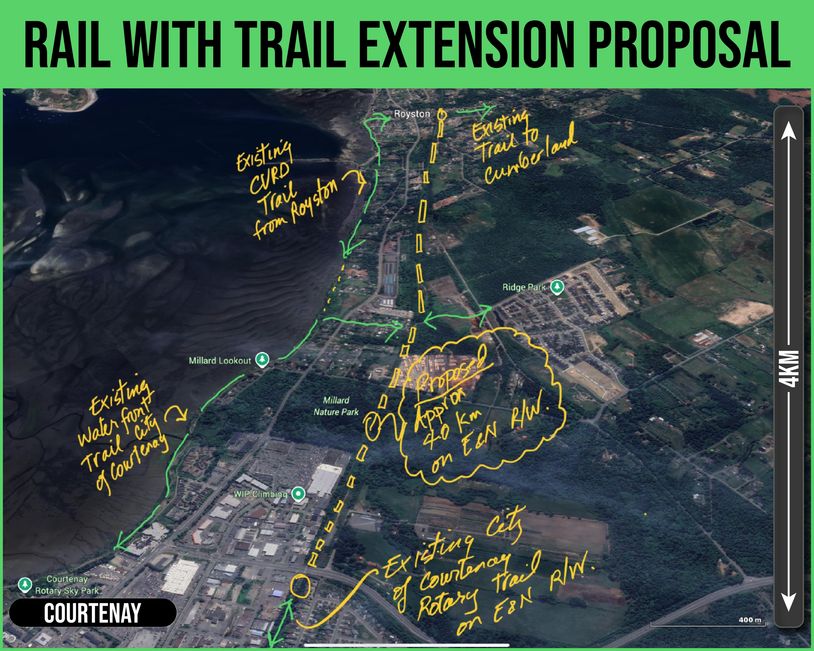
This gravel nature path proposal was sent to Island Corridor Foundation in June 2026, updated in August, 2026 and is being considered.
Discovery: Proposed Trail includes a section where a new watermain is to be installed for Royston and Komox First Nation.
Powered by Islanders
Vancouver Island, British Columbia , Canada